
The Pilot
Six Decades of Devotion


Dad is a father, a husband, a community leader. Dad is a builder and a manufacturer. He is an advisor and confidant. Dad is the essence of the American spirit. He is also a flyer, a life-long private pilot.
Our father, Fred T. (Tim) Yoder was born in the middle of WWII. The second son to two quintessentially devoted Americans, Fred and Dorothy Yoder. Tim, as he was commonly known, grew up in southwestern Ohio knowing there was no limit to one’s wishes so long as one pursue them with full devotion. To utilize the optimistic turn of the 20th century phrase that the Yoder family lived by, ‘the sky’s the limit.’
In 2022 I sat with Dad to interview him about his love of flying. This short essay is a result of that interview.
A Pilot is Born
Dad’s grandfather, Dennis Percival (DP) Yoder was a turn of the century entrepreneur. In Snyder, Texas, DP’s Chevrolet Motorcar dealership was up and running by 1920. DP owned the local power company and parlayed that into ownership of the ice house as well; critical in the warm clime of west Texas. DP Yoder opened the first airport in Snyer, Yoder Field, an air field where he housed and flew a Curtiss Robin (with OX-5 engine). The town had a plane and could be accessed by air. Business could flourish.
DP’s son Fred (my grandfather) had at sometime earned a student license. So flying was in the family before Tim even came along.
About 1955, at the age of 12, Tim accompanied his older brother Glen and their mother Dorothy on a business trip to New York on a TWA flight in a Lockheed Constellation. It was an interesting first flight for Tim. The aircraft and the trip stuck and would linger in memory for nearly 70 years.
While a senior at Miami University in Oxford, Ohio, Dad spotted a bulletin board. The Air Force ROTC program was offering their trainees a chance to get flight training while enrolled at Miami University. There were a few unfilled slots available for anyone who might be interested, so Dad accepted.
“It was easy and fun. To my memory, the total cost was about $380.00 — about half price for the time. That included forty hours of flight time which was charged at $5.00/hour, a physical which cost five dollars, maps, plotters, and other ancillary equipment. The instructors probably got about $160.00.”
The culminating solo flight was sprung on him a little early. After only eight hours of flight time the instructor turned the Cessna 150 over to Dad. Executing a successful solo flight meant taking off and landing to a full stop three consecutive times. He did it October 25, 1965.
Dad used only thirty eight and a half hours of education and training to complete his FAA check ride, leaving him an hour and a half more of free flying time. Tim had earned his pilot license.
Suddenly flying took a back seat to supporting his new family with Mom. Jason and I were both born in the late 1960s. There was little time or money to put toward flying.
After serving the United States in the US Army in South Korea, Dad’s brother, Uncle Glen, utilized part of the GI Bill to get his own pilot’s license. He was inspired by his younger brother Tim.
Brothers Glen and Tim left Ohio for the west. Though they left Ohio in each their own time, both found themselves with their young families living near one another in the Valley of the Sun in 1966. They were destined to fly together for decades.
Bouncing from employment with Garrett AiResearch in Phoenix, to Kaiser Aluminum in Houston (1968-1973) Tim found sparse flying opportunities.
“What would you say are your favorite aircraft, Dad?”
“Probably the P-40. I always liked Chennault’s Flying Tigers. But Howard Hughes’ H-4 Hercules (the Spruce Goose), the Concorde, the Lockheed U-2, and the SR 71 Blackbird also stand out as inspiring, favorite aircraft.”
A relocation back to Phoenix in 1973 brought the brothers back together. That’s the year Glen bought a Cessna. They flew together. Dad got checked out again and was piloting a Beechcraft Bonanza (also owned by Glen) in 1978.
Now the brothers flew out of Falcon Field Airport in Mesa, Arizona. Business flights to view real estate investment ideas and to photograph construction projects that were underway were not uncommon. Sometimes there were day flights for the two to Bullhead City or Las Vegas. More commonly there were short breakfast flights to Payson or Sedona with a family member or friend. In 1986 they shuttled me from Flagstaff back to Falcon Field.
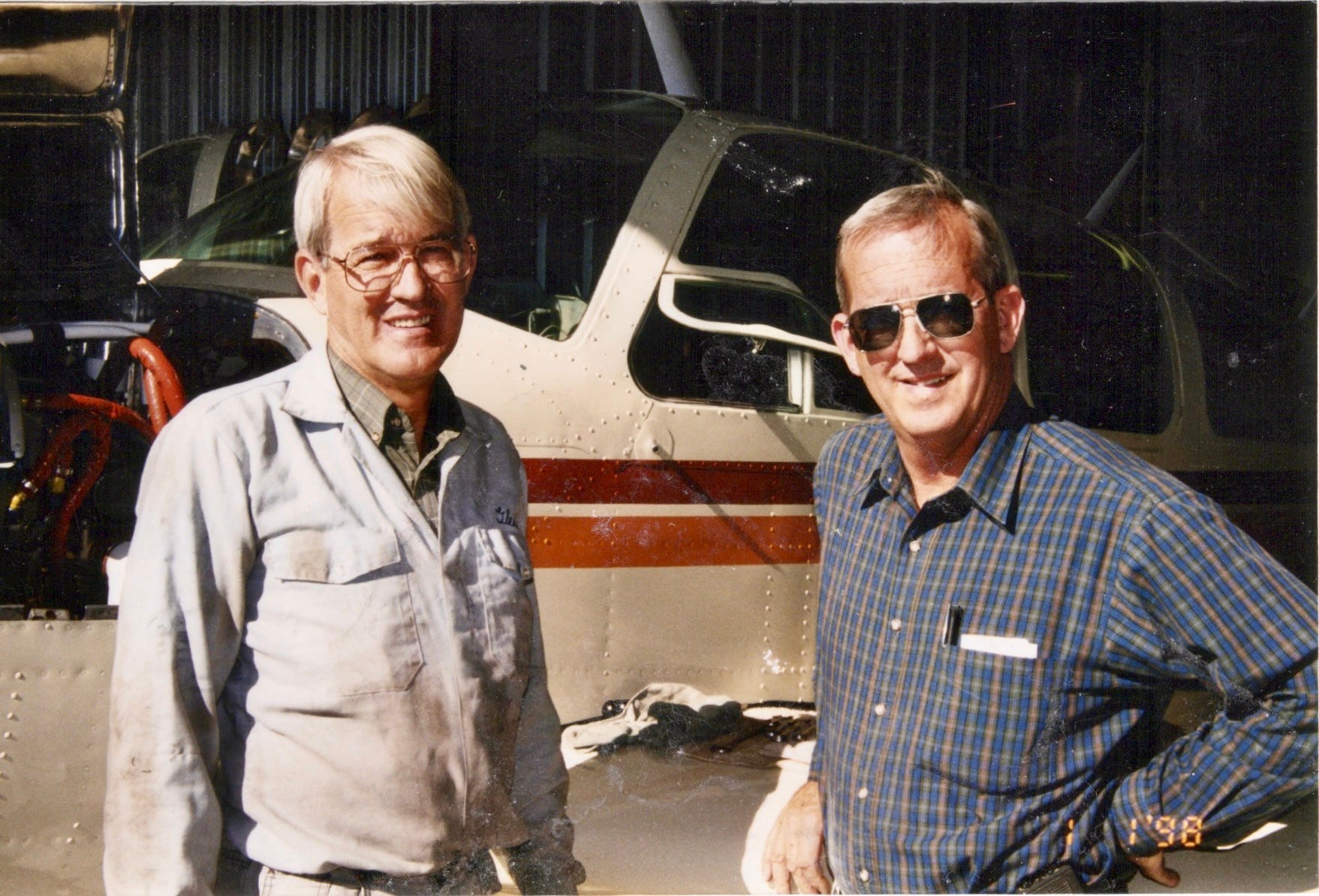
Brothers Glen and Tim in typical fashion at the hangar.
It was about then, in the mid 80s, that Dad and two associates partnered to purchase a famous two seater airplane called an Ercoupe. First developed by Fred Weick in the 1930s, the Ercoupe is known for its simplistic controls, inability to go into a spin, and other groundbreaking engineering that makes the plane arguably the safest ever.
Within a couple of years, Tim tired of sharing the Coupe with other owners. Brother Glen flew Dad to the Sacramento area to look at another Ercoupe. After a test fly with the owner of that craft, Dad purchased it. His first airplane.
Aircraft Builder
The Ercoupe was a wonderful plane, but it’s an old craft (the last one was manufactured in 1969) and Dad was considering the impending need to do a full re-build on it.
In a bid to fly a faster, more modern airplane Dad purchased a kit plane from KIS in Oxnard, California. Why not direct all the work needed on the Ercoupe toward something totally new? It was December 11, 1993.
Kit planes require some level of construction. The engine and instruments are a separate purchase and are usually not included in the kits. Planes of this nature are defined as “Experimental.” Their devotees are regular members of the Experimental Aircraft Association (EAA) with more than 250,000 members worldwide.
There are several advantages to building your own airplane over purchasing a government certified aircraft (Beechcraft, Cessna, Piper, etc). Firstly, a kit plane is about a third of the cost of a certified plane. Annual registration is a mere $25.00 per year. And as Dad happily mentioned, “they tend to be lighter, smaller, faster AND you can be your own mechanic.”
In the case of Dad’s kit KIS, it was a fiberglass kit which looked nearly identical to the toy store plastic Revell model airplane — only life size.
Dad’s technical education, his manufacturing background, and his preference for mechanical work would be put to use in the ultimate expression — building and flying his own airplane. Of necessity, he would also become a master fiberglass fabricator. Fortunately for him, he had a friend who was equally interested in the project and worked side by side with Dad for years to complete the project. Trent Heidke dedicated nearly 2000 hours of labor to Dad in that hangar at Falcon Field.
All told, it took 5000 hours of work to assemble the plane, install the engine, instrumentation and to install the communication system. No detail was spared.
One day the subject of the maiden flight came up. I asked, “What’s the deal with the first flight? When’s that happening and are you even gonna’ do that?”
“Well, the ground testing is going well. I could do the first flight or I could hire a professional. There are people who specialize in test flights and maiden flights. What do you think?”
I considered his question.
“Dad, I don’t think anyone can know the plane as well as you do. It must be a scary position to be in, but I think you should make the first flight if you think you can do it. Just think about the Wright brothers. Not only did Wilbur and Orville make a maiden flight, they were unlike you because they had never flown before. On top of that, your equipment and the plane’s engineering is exponentially more safe than the Wright brothers’. Plus, there’s the glory factor! What percentage of pilots make maiden flights?!”
The maiden flight was on December 12, 1998. Five years and a day after taking possession of the kit. Dad was at the controls.
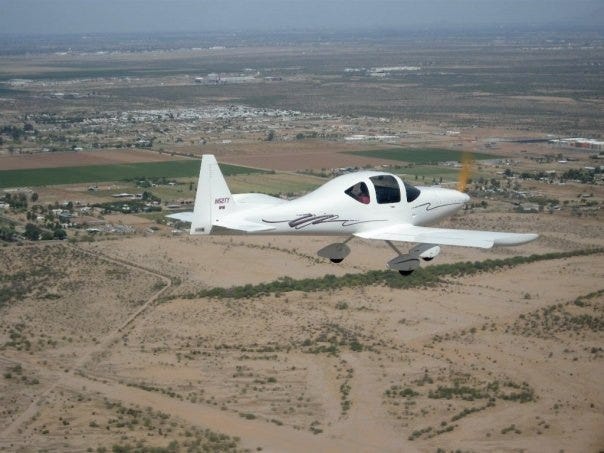
Dad in the KIS
That’s when Dad earned the FAA’s Repairman Certificate for Amateur-Built Aircraft.
A round-trip to Lakeland, Florida in his new aircraft in April 1999 was called for. The Sun n Fun Aerospace Expo is Florida’s largest annual convention of any kind. It was the perfect event for our family’s sport aviation enthusiast and aircraft builder to attend as celebration for his accomplishment.
“That must have been close to the most distant destination you ever flew to. To which other distant places have you flown as a private pilot?”
He recalled:
Flights with his brother to Cincinnati,Ohio, Nashville, Tennessee, San Diego, California, Texas, and to Minnesota once or twice. After completing his KIS he flew to Oshkosh, Wisconsin three separate times; once in his KIS, once in Trent’s Commander, and once in Trent’s Cirrus.
The longest single leg flown, about 5 hours 20 minutes (6 different times).
In his life he’s flown about 10 different planes.
“How many hours to you have behind the controls?”
“Only about 1500. Not an especially high number, but those flying hours are spread out over seven different decades.” Dad added.
“Dad, tell me about any exciting mid-air moments you had over the years.”
“There’ve been several interesting moments,” he went on. “A few were in Glen’s plane and a few were in mine.”
In the Beechcraft Bonanza we were coming back from Texas at 10,000 feet. Suddenly we saw a hawk coming right at us. With no time even to duck, the bird went through the prop and hit the leading edge of the wing, leaving a good dent.
Flying to Bullhead City (again in Glen’s plane) we were around Wikiup and we hit a wind sheer so severe that Glen’s head cracked the window on the door.
On my flight to Sun n Fun in the KIS, I hit a rotor (a phenomenon of turbulent air) which pitched the plane straight up. I was only seeing blue sky when the wheel chocks I had on the hat shelf in the back flew up and struck me in the back of the head.
Later in the KIS, the throttle got stuck open. The throttle control came loose which was my error. I used the mixture to reduce the fuel supply to land. The engine quit just before touchdown, but I had enough speed to roll out and clear the runway and taxiway before the plane came to a stop.
Again in the KIS the mechanical fuel pump quit in flight. That was not my error. Trent was with me and he pumped the primer to keep the engine running enough for us to get back to the airfield and land. On that one, we thought we might have to make an emergency landing along the canal. Luckily that was avoided.
Oh, and one more early one back in Glen’s plane. We were flying near the Arizona-New Mexico border and one of the two ignition magnetos [which keep high voltage going to the spark plugs] went out. We had a sudden drop in power. The other magneto was working fine at that point but we decided to land right there in St. John’s, Arizona and make the repair rather than take the risk. Of course, there were no available parts in St. John’s so we had to rent a car which leads to a whole different story. The short form is, with minor delay we got the plane fixed and back home.
Overcoming Other Obstacles
In the early 2000s Dad ran in to some serious medical issues with a heart condition. That was bound to create problems for him when it came time for the prescribed Federal Aviation Administration (FAA) physical exam. Physicals are a requirement to fly certified and experimental aircraft.
Luckily, the FAA created a new Light Sport Aircraft (LSA) category. Certain small, lightweight, “easy-to-fly” aircraft fall into this category. A benefit of piloting these is that medical certification is achieved simply by holding a valid driver’s license — so physicals are not required. One still needs to possess a valid pilot license to pilot light sport aircraft, of course.
Sadly, the KIS does not qualify as a LSA. It’s too heavy and too fast.
The Thorp T-211, an American, two-place, all-metal, homebuilt aircraft fell into the LSA category because of its slower speed. For more than a decade, dad happily made that his airplane of choice. Eventually, the low wing configuration of the Thorp made getting in and out of the plane cumbersome.
Ever resilient, Dad found the solution to that problem in the Vashon Ranger, a LSA with a high wing. Getting in and out of the cabin is much easier.
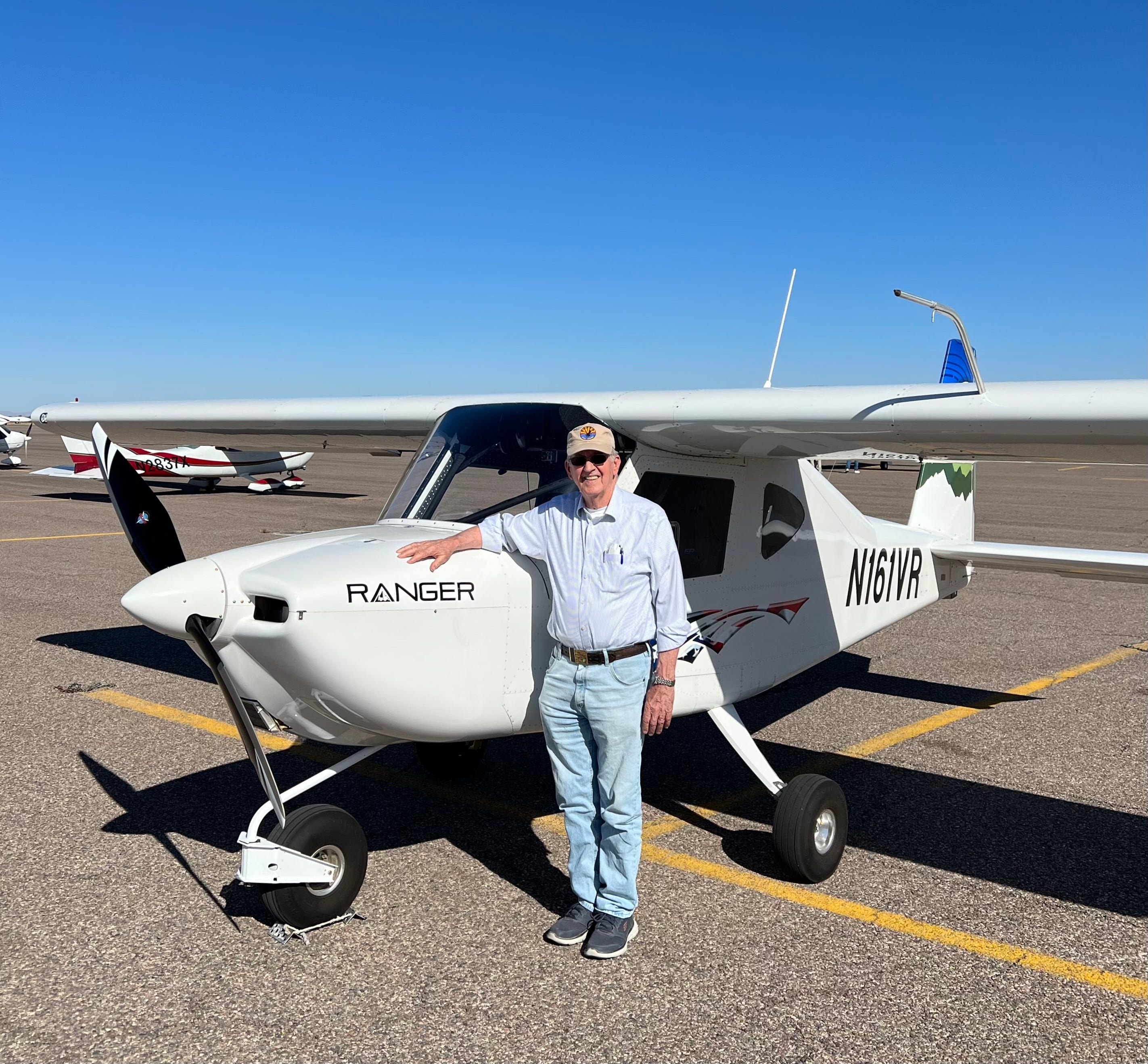
As of June 2025, Dad’s been flying the Vashon Ranger for many years.
The Federal Aviation Administration recognized him in spring of 2024. Fred T. Yoder was honored with the “Wright Brothers Master Pilot Award” for at least 50 years of exemplary aviation flight experience, distinguished professionalism, and steadfast commitment to aviation safety.
The sky’s the limit!
This bio written using 100% HI (Human Intelligence), 0% AI (Artificial Intelligence).